Dual-gatekeeper

Trajectory Planning for Safe Dual Controlwith Active Exploration

Kaleb Ben Naveed1 Manveer Singh1 Devansh R. Agrawal1 Dimitra Panagou1,2

University of Michigan, Ann Arbor

1 Department of Robotics2 Department of Aerospace Engineering

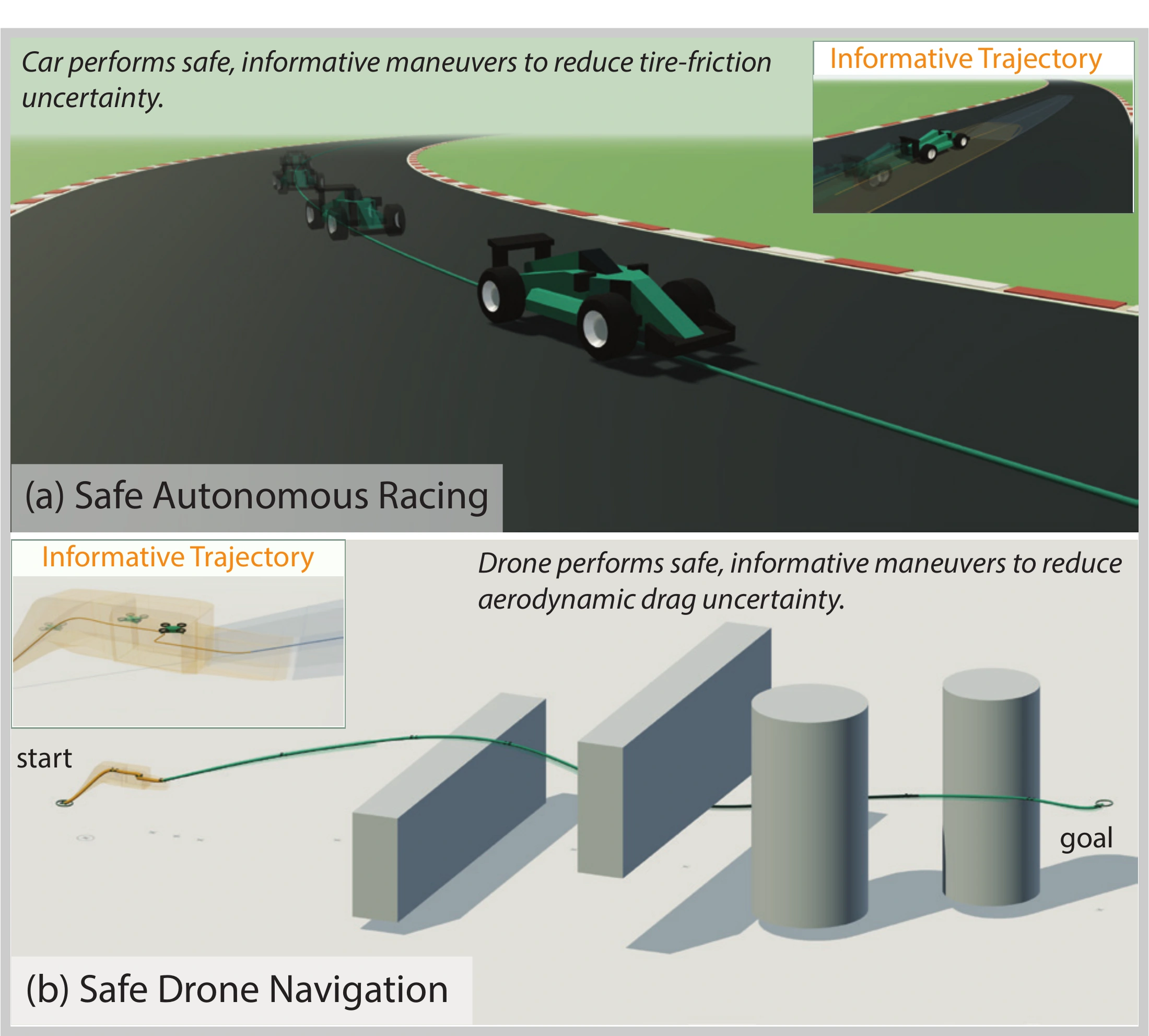
Two simulation scenes: a racing car on a circuit above, and a drone navigating walls and columns below. Insets show informative trajectories in orange; mission motion is teal.
Active exploration within the mission. Committed informative trajectories reduce tire-friction uncertainty in autonomous racing and aerodynamic-drag uncertainty in drone navigation.

See the framework in motion

Supplementary video

Watch on YouTube

Autonomous racing and drone navigation, including informative trajectories and comparisons with passive, weighted-information, and no-learning baselines.

The central idea

Learn the dynamics while completing the task.

Uncertain dynamics can make safe motion conservative. Deliberately informative motion can reduce that uncertainty, but it also takes time and effort. When should a robot explore?

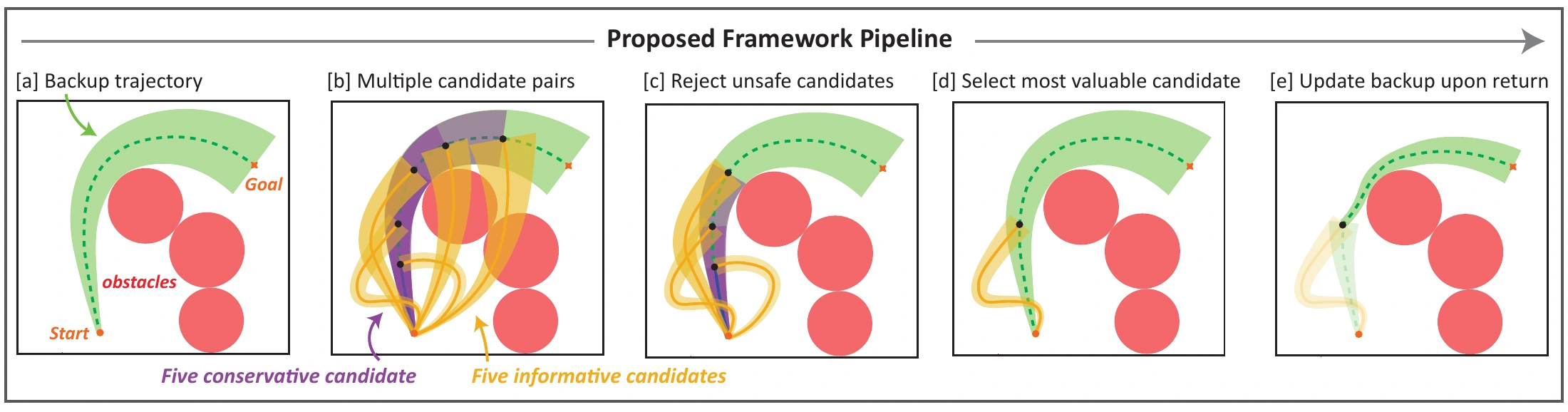
Dual-gatekeeper treats exploration as a decision to verify before execution. The framework considers conservative and informative candidate trajectories, checks their safety and budget feasibility, and selects a feasible informative candidate using its predicted uncertainty reduction. Otherwise, it retains the backup policy.

Measurements collected during execution update the admissible model-parameter set through set-membership identification (SMID). The robot then replans with the updated uncertainty set. The same decision framework supports both deterministic and probabilistic safety verification.
Method overview

From candidate trajectories to a committed decision

Five panels show a backup trajectory, conservative and informative candidates, rejected unsafe candidates, a selected candidate, and an updated backup plan.
Candidate generation, rejection, commitment, and replanning. The physical scene is an illustration of trajectories in state space.
  1. 01

    Generate candidate pairs

    Construct conservative and informative alternatives over candidate horizons using the current model estimate and uncertainty set.

  2. 02

    Verify safety and budget feasibility

    Check the prescribed safety conditions, including the transition to the backup or fallback policy, and reject candidates that exceed the remaining exploration budget.

  3. 03

    Commit an informative trajectory

    Rank feasible informative candidates by predicted uncertainty reduction, discounted by horizon length. Retain the backup policy when no suitable informative candidate is available.

  4. 04

    Update the uncertainty set

    Use the collected measurements to refine the SMID parameter set, update the plan, and repeat the decision process during the mission.

Two safety instantiations

One decision framework, different verification methods

Deterministic · Drone navigation

Robust tube verification

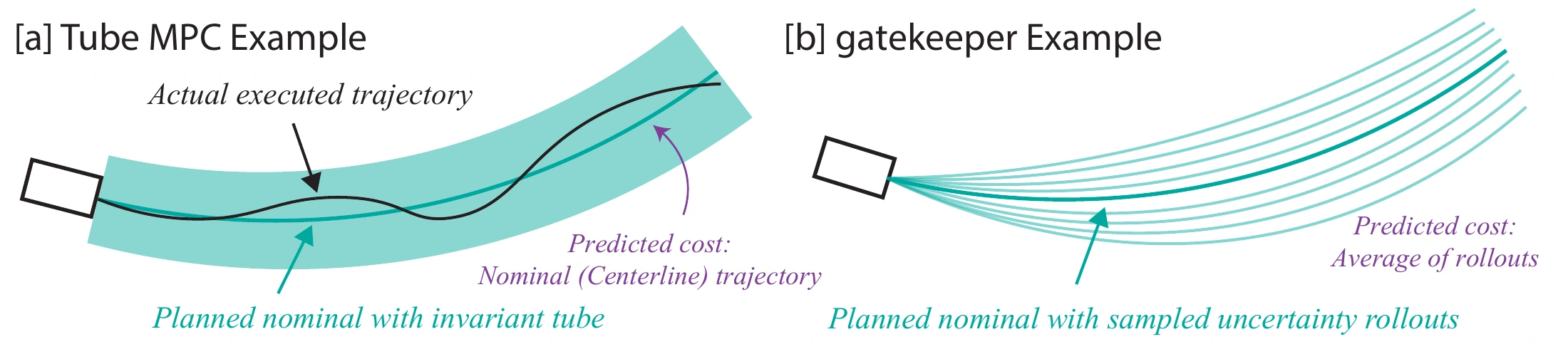
Robust tubes bound closed-loop trajectories for all model parameters and disturbances within the stated bounds. An informative candidate must satisfy the constraints throughout execution and safely rejoin the backup tube.

Probabilistic · Autonomous racing

Sampling-based verification

Sampled closed-loop rollouts evaluate each candidate and its fallback transition. An exact binomial upper confidence bound is compared with the allowed failure tolerance under the assumed uncertainty distribution.

Left: a nominal trajectory enclosed by a robust tube. Right: sampled closed-loop trajectories under uncertain dynamics.
The tube-based representation and the sampled-rollout representation. Probabilistic safety allows a prescribed failure probability; it does not assert that every realization is safe.
How racing candidates connect to the fallback policy

Both conservative and informative racing candidates include their transition to a fallback policy. Each candidate policy is verified before commitment; nominal performance alone does not establish safety.

Fallback and nominal policies generate conservative and informative candidates. Unsafe candidates are rejected, leaving verified candidates for commitment.

Explore the simulations

Two tasks with uncertain dynamics

Three drone obstacle configurations alongside a racing circuit comparing proposed, passive, and weighted-information trajectories, with two track close-ups.
Scenarios and trajectory comparisons from the paper. Orange highlights informative motion; teal shows mission motion.
01 / Autonomous racing

Learn tire–road friction on the circuit.

Informative trajectories excite the vehicle dynamics to reduce friction uncertainty. The racing demo compares the proposed method with passive learning, different information weights, and no learning.

Open the racing demo
02 / Drone navigation

Learn aerodynamic drag around obstacles.

A quadrotor navigates walls and columns while reducing drag uncertainty. Three scenarios show how informative trajectories and updated uncertainty bounds interact with the navigation task.

Open the drone demo

Reference

Citation

@misc{naveed2026dualgtk,
  title={Trajectory Planning for Safe Dual Control with Active Exploration},
  author={Kaleb Ben Naveed and Manveer Singh and Devansh R. Agrawal and Dimitra Panagou},
  year={2026},
  eprint={2604.15507},
  archivePrefix={arXiv},
  primaryClass={cs.RO},
  url={https://arxiv.org/abs/2604.15507}
}